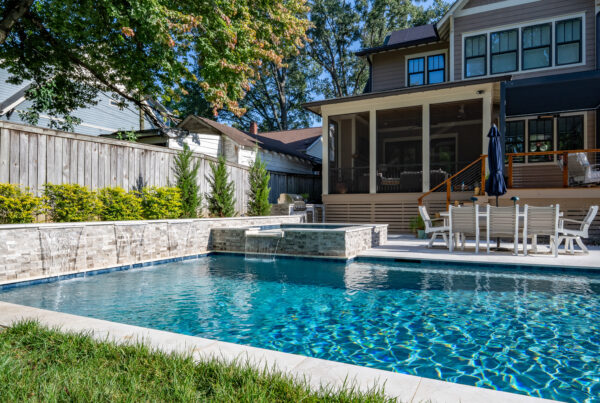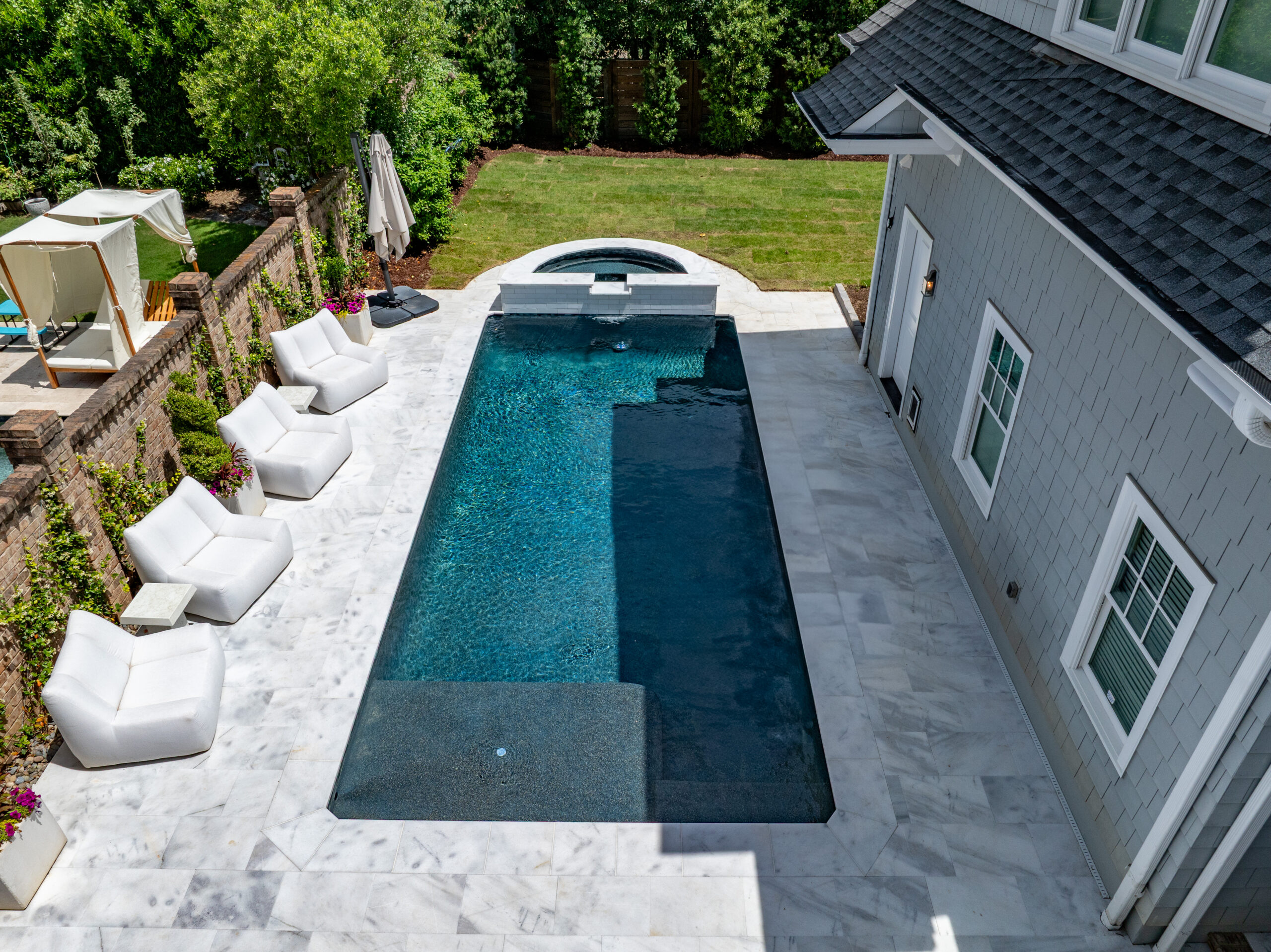
Adding an in-ground custom pool to your home is one of the most rewarding ways to transform your backyard into an inviting outdoor sanctuary. Beyond enhancing your daily lifestyle, a well-engineered concrete pool provides year-round aesthetic beauty, creates a social hub for family gatherings, and increases overall property value.
However, many homeowners across the Charlotte metro area, particularly in historic neighborhoods like Dilworth and Plaza Midwood, or modern close-lot communities in Myers Park, South End, and SouthBallantyne, face property space constraints. Municipal setback requirements, local utility easements, and natural grade changes can limit the space available for a massive pool footprint.
When evaluating options for smaller or awkwardly shaped Charlotte lots, homeowners often weigh two primary solutions: a compact plunge pool or a full-sized custom concrete pool. Understanding how each style compares in footprint, functionality, hydraulic demands, and property integration will help you choose the best fit for your home.
What’s the Difference Between a Plunge Pool and a Traditional Pool?
Before comparing property constraints, it is helpful to establish standard industry dimensions for each type of pool:
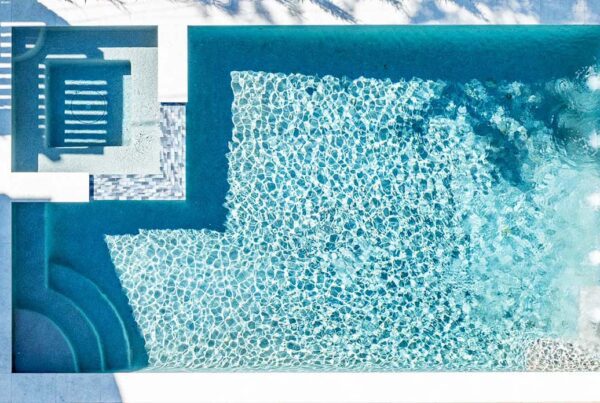
- Plunge Pools (Cocktail Pools / Spools): Plunge pools are intentionally compact. They typically range from 6 feet to 12 feet wide and 10 feet to 20 feet long, with a uniform flat-bottom depth of 4 to 5 feet. Designed primarily for cooling off, hydrotherapy, standing leisure, or aquatic relaxation, plunge pools emphasize intimate seating and space efficiency.
- Full-Sized Custom Pools: Traditional custom pools usually start around 14 feet to 16 feet wide and extend 28 feet to 40 feet or more in length. They often feature variable depths (ranging from a 3.5-foot shallow end to a 6-to-8-foot deep end) and accommodate active swimming laps, water sports, and large social gatherings.
Evaluating Your Backyard: Local Lot Factors in Charlotte
When deciding between a compact plunge pool and a full-sized custom build, local lot dynamics dictate what can physically and legally be constructed on your property.
Municipal Setbacks and Easements
Every county and municipality across the region, including Mecklenburg, Union, and York counties, enforces specific zoning rules. These regulations require pools and surrounding hardscapes to sit a specified distance (setback) away from side and rear property lines. Additionally, recorded utility or drainage easements may restrict construction on portions of your yard.
On tight urban or suburban lots, a 20×40-foot pool can consume the entire buildable area, leaving no room for a patio, outdoor kitchen, or green space. A 10×16-foot plunge pool easily respects local setbacks while reserving ample square footage for hardscaping, fire features, and landscaping.
Topography and Site Grading
The Charlotte Piedmont area is known for rolling hills and sloping yards. Installing a full-sized pool on a sloped site often requires heavy excavation, extensive retaining walls, and complex engineered drainage to manage storm runoff.
A plunge pool carries a significantly smaller excavation footprint. This compact shape makes it easier to tuck into terraced slopes, side yards, or sloped courtyards, minimizing structural retaining wall costs.
Lifestyle Comparison: How Will You Use Your Custom Pool?
A custom pool should match your daily routines, entertaining preferences, and exercise goals.
Choose a Plunge Pool If:
- You want a multi-season retreat: Because plunge pools hold significantly less water volume (typically 3,000 to 8,000 gallons vs. 20,000+ gallons in a traditional pool), heating them is fast and cost-efficient. Adding a heater or hydrotherapy jets transforms a plunge pool into a “spool” (spa-pool hybrid) that can be enjoyed during cooler autumn and winter months.
- You prioritize outdoor living balance: If your dream backyard includes a covered patio, an outdoor kitchen, a fire pit, and a lawn area for pets, a plunge pool delivers the luxury of water without crowding out other outdoor features.
- Your primary focus is cooling off and relaxing: A plunge pool provides a place to float, read, or socialize with a cold drink in hand during hot, humid summer days.
Choose a Full-Sized Custom Pool If:
- You have an active family: If you have children or grandchildren who want to dive, play water volleyball, or swim with large pool floats, a traditional pool provides the necessary space.
- Fitness is a primary goal: For homeowners who want to swim laps or conduct aquatic resistance workouts, a pool length of at least 28 to 30 feet (or a dedicated lap pool) is recommended.
- Your lot easily accommodates it: If your property offers ample buildable area beyond local setback lines, a full-sized custom concrete pool serves as a resort-style focal point for your landscape.
Construction Engineering and Turnkey Design Integration
Whether you choose a compact plunge pool or a full-sized architectural showcase, custom concrete (gunite/shotcrete) construction offers total design flexibility. Unlike pre-formed fiberglass shells or vinyl liners that come in fixed factory shapes, a custom concrete pool can be engineered to match the exact boundaries of your yard.
Partnering with an integrated design-build contractor ensures your pool is constructed to heavy-duty structural standards, such as #4 rebar spaced tightly at 10 inches on-center over a solid gravel sub-base. Furthermore, a single design team coordinates pool hydraulics, automated Jandy filtration, custom hardscapes, low-voltage lighting, and site drainage under one unified project scope.
Conclusion
Neither option is inherently superior; the right choice depends on your property dimensions, lifestyle goals, and budget. Plunge pools provide a space-saving, energy-efficient solution that fits tight urban lots while leaving room for hardscaping and outdoor living elements. Conversely, a full-sized custom pool offers an expansive aquatic arena for active families, water sports, and large-scale entertaining.
By carefully measuring your buildable lot area, reviewing local zoning setbacks, and working alongside a trusted design-build partner, you can create an outdoor retreat tailored precisely to your Charlotte home.